The Packard That Cheated Death: The True Story of the Turnpike Phantom
Watch the Classic Car Club of America Museum’s inaugural edition of “Classic Tales”
The Packard and the Turnpike Phantom
In 1937, 49-year-old Frank M. Shattuck of Syracuse, New York, decided to order a Rollston Company-bodied 1937 Packard 1508 Convertible Victoria. Shattuck’s father was Frank G. Shattuck, who was the owner of Schrafft’s Candy Company. Frank G Shattuck acquired the growing business, which was founded in 1861, from the Schrafft family in 1929.
Many members of the Shattuck family were involved in the operation, which in time grew into a $20 million per year business with 50 different stores and restaurants operating in New York, Massachusetts, and Pennsylvania by the late 1930s.
Frank M. was on the board of directors for the company and served as a key advisor for his father, while also managing the Syracuse, NY, location for over forty years. Mr. Shattuck’s Packard was used to make regular trips from his home in Syracuse to New York City, where Schrafft’s corporate office was located.
It seems likely that Frank M. was thinking of his large family when he was considering his new Packard. He and his wife Genevieve had 5 children, and while the entire family could not fit in the car together, those family members who could accompany him would have plenty of room to stretch out between the 144” wheelbase. 1937 would be the last year a wheelbase this long was available in a Packard Twelve.
According to the surviving Rollston cut sheet, the car was originally ordered in black with white pinstripes, a tan Haargz convertible top, black leather upholstery with individually adjustable front seats and a folding center armrest, and dark walnut wood trim throughout the cabin.
Rudolph (Rudy) Creteur was the Rollston designer who penned the design, known internally as Style No. 1613, first drafted in December 1936. It must have been challenging to create an elegant-looking two-door convertible on a chassis ordinarily used for limousines, but Mr. Creteur was clearly up to the task.
The beltline is tall, with a gentle upsweep in the front third of both doors, which meets nicely with the cowl at the
base of the windshield. The doors are impressively long, and both feature dual inner releases to allow for easier exit of rear seat passengers. The relatively short rear flank is only made possible by an extremely lengthy convertible top, which meets a small and raked windshield that combines with a low roofline for a sporty look that manages to
convey both power and elegance.
Like many coachbuilders of the era, the Great Depression had a dramatic impact on Rollston’s profits in the 1930s. When the cut sheet for this car was typed, the company was less than a year from bankruptcy, though Mr. Creteur and three other partners would go on to found Rollson Inc. in late 1938, continuing to build bodies mostly for
Packard before the war.
Mr. Shattuck is believed to have kept the car until the early 1950s. In 1953, the car was advertised for sale by Paul Lutey for the bargain price of $475. The advertisement caught the attention of Pittsburgh resident Ernest Stern, who would later own Stern Motor Museum.
Stern sent a young Packard enthusiast by the name of Edward J. Blend by train into the Bronx in New York to complete the purchase and drive the car back to Pittsburgh. Mr. Blend’s trip through Pennsylvania back to Pittsburgh provides an interesting and near-tragic story involving the car, outlined in Blend’s autobiography.
After driving almost 200 miles out of New York City, Blend found himself on the Pennsylvania Turnpike near Carlisle at 9:00 PM. Tired from a long day and concerned about driving through the dark in a car with only one working headlamp and no instrument lights, he decided to park on the side of the road and resume his trip in the morning.
Mr. Blend was all too aware that earlier that summer, the Pennsylvania “Turnpike Phantom” had been making headlines, with two truckers recently murdered in their sleep while parked on the side of the highway. As a precaution, he armed himself with the Packard’s lug wrench across his lap for protection before falling asleep.
Late that evening, Mr. Blend recounted that he was awakened in the night by the sound of a car pulling up behind him. Hearing the sound of approaching footsteps along the side of the car, the Packard’s door was suddenly opened, and Mr. Blend started swinging his wrench. His would-be attacker fled back to his car and sped off, in what Mr. Blend believed was a 1930s-era Dodge or Chrysler.
That October, 24-year-old John Wesley Wable was arrested while driving a 1936 Dodge, and later confessed to the Pennsylvania Turnpike Murders earlier that summer. Mr. Blend was confident that he was very nearly another one of Wable’s victims.
The story of the Packard and the Phantom reenacts the autobiographical account of Edward Blend’s road trip from the Bronx to Pittsburgh in 1953, including Blend’s alleged
encounter with the Pennsylvania Turnpike Phantom.
The Rollston-bodied 1937 Packard 1508 Convertible Victoria that Blend drove on that trip is a part of the CCCA Museum’s collection today. The CCCA Museum displays Full Classics® – rare and expensive automobiles of distinction built between 1915 and 1948- and is one of seven partner museums on the beautiful 90-acre campus of the Gilmore Car Museum, which features over 400 cars and almost 220,000 square feet of display space in Hickory Corners, MI.
In addition to Packards, the CCCA Museum features 46 automobiles on display from Classic Era luxury carmakers like Cadillac, Delahaye, Cord, Stutz, Lincoln, Bentley, Rolls-Royce, and many others. The museum also features over 700 distinctive mascots on display, a research library, and the digital archives of coachbuilders Derham, Judkins, The Cole Motor Company, and the papers of Ray Dietrich.
More information can be found at cccamuseum.org
By John Hansen
Executive Director Classic Car Club of America Museum
Image via John Hansen
.
Sign up for updates

YOU MAY ALSO LIKE
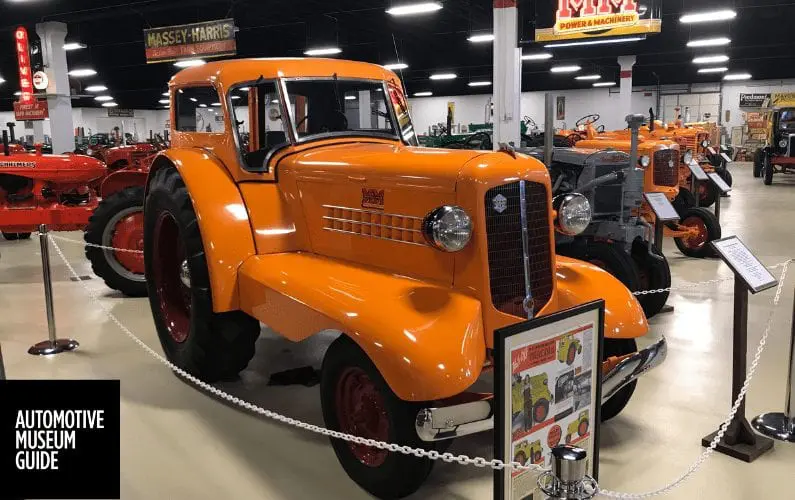
Visiting Keystone Truck and Tractor Museum
The Keystone Truck and Tractor Museum in Colonial Heights, Virginia is a fantastic automotive museum full of over 150 antique tractors and more.
Visiting the Tampa Bay Automobile Museum
The Tampa Bay Automobile Museum is a must stop place if you’re in the Tampa, FL area. If you’re cruising out of Tampa take a few extra hours and stop by.
The Panoz Museum
The Panoz Museum in Hoschton, Georgia, is a must-stop for any automotive enthusiast, especially race fans. Not only is the Panoz handmade right on site, but they also display various models in the museum, as well as some of the actual race cars and racing memorabilia....
Visiting the Mustang Museum of America
I recently had the opportunity to visit the Mustang Museum of America in Odenville, Alabama and I’ve got to say I was really impressed especially once I was told how recently the museum started.
automotive museum guide
get updates
Sign up to get updates about automotive museums right to your mailbox. Don't miss a thing. It's FREE.
SEARCH FOR AUTOMOTIVE MUSEUMS
We created the ultimate resource of America's Automotive Museums.